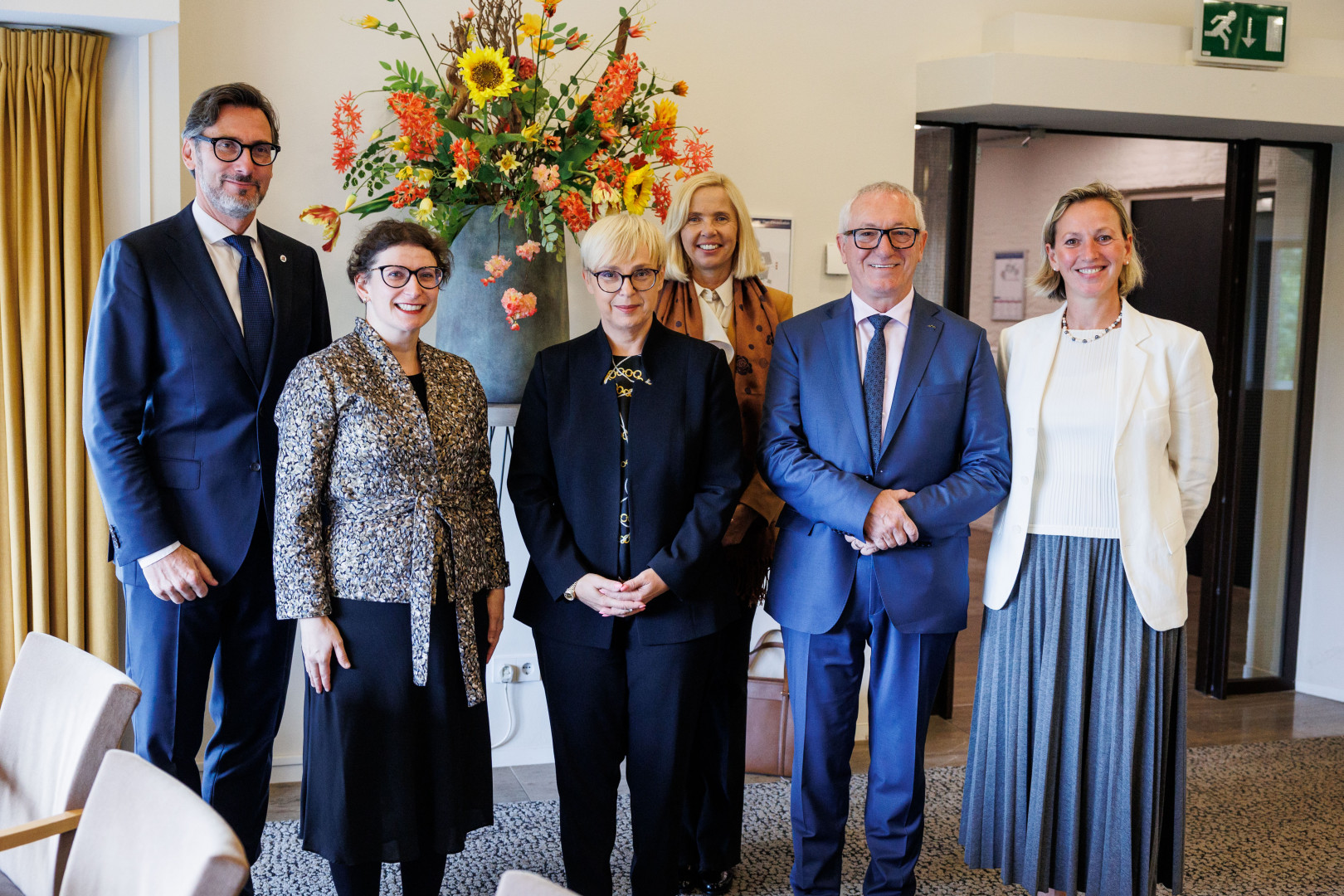
Predsednica republike na srečanju s sodnico Beti Hohler, 16. septembra 2024, v Haagu. Photo: Nebojša Tejić/Slovenian Press Agency
Joint letter of the President of the Republic and the Prime Minister in support of the International Criminal Court and Judge Beti Hohler
Below is the text of the letter of support for the Slovenian judge of the International Criminal Court, Beti Hohler, who is facing serious consequences as a result of sanctions imposed on her by the United States in June last year. The letter was co-signed by the President of the Republic of Slovenia, Nataša Pirc Musar, and the Prime Minister of the Republic of Slovenia, Robert Golob. It is addressed to the Presidents and Heads of State and Government of the EU Member States, as well as to the President of the European Commission and the President of the European Council.
Publish date Ljubljana,
Dear friends,
International criminal justice was forged in the aftermath of the catastrophe of the WWII. The generation that built the first international criminal tribunals understood, because they had lived through the alternative that peace requires institutions strong enough to hold power to account. The International Criminal Court is the living expression of the promise “Never again”. And today, it is under attack.
Court's judges and prosecutors have been targeted by coercive measures. Some by sanctions, some by criminal procedures, some by both. Among them, also European nationals, including a national of Slovenia, Judge Beti Hohler. Judges are subjected to coercive measures for exercising their judicial mandate, for issuing decisions in cases before the Court. For performing their judicial functions in accordance with their judicial oath. The consequences of these coercive measures are severe and immediate. Travel is restricted, bank accounts closed, credit cards cancelled, financial transactions blocked, even by some European banks. Health insurance reimbursements unpaid. Visas revoked and assets frozen. What is more, coercive measures do not just impact the targeted officials but also their families.
Europe’s response so far has not matched the gravity of the situation. Too often, concern for economic consequences has taken precedence over a principled defence of judicial independence and international justice. Not for a Union that claims to stand for the rule of law. Not at a moment when armed conflicts rage, when international law is being violated, when the victims of the gravest crimes look to the ICC as their last hope for justice. We owe it to those victims not to be silent. We owe it to the children killed in conflicts the world watched unfold on its screens. They deserve more than cautious language. They deserve a Europe that acts and decisively protects the Court to fulfil its mandate.
We need to act now, because fundamental European values cannot carry a price tag. The moment they do, we know from our own history where that leads. There is no longstanding peace without justice. We need to stand together and speak with one voice, clearly and without hesitation. The independence of international courts is non-negotiable. Future generations will ask whether we acted when international justice and the rule of law were threatened. History will judge how we responded. We intend to be on the right side of it.